Needed: perches for pest controllers

06_pest-control_web

THIS can be a win-win situation. Recent photographs I took of raptors often show them sitting on a pole: both while scouting for prey on the ground below, or to consume the prey once caught. While traveling in the Eastern Cape earlier this year I caught a glimpse of a Jackal Buzzard carrying what looked like a wig while flying across the road and alighting on a telephone pole. It turned out to be a hapless Long-tailed Widowbird and the buzzard spent the next 10 minutes or so to rip it to pieces and swallowing it. Back at home in Boston I saw a Long-crested Eagle sitting on a fence pole in the wetland. Its patience paid off when it pounced and emerged from the vegetation with a rodent. That was supper sorted. Another picture of a Rock Kestrel on a pole revealed the bird holding a rat it had caught. Some of the perches used by the raptors include temporary structures, like an irrigation pivot, or freshly cut hay bales. A pair of juvenile Jackal Buzzards wasted no time to install themselves on a bale in a field cut the day before, while Gustav found a feather from a Spotted Eagle-Owl next to a gate pole. Finally the penny dropped, and I thought that if farmers and landowners were to put up more perches for raptors in agricultural fields without trees or telephone poles nearby, that would be to the benefit of both parties. It will make it easier for the pest controllers to hunt from a perch and farmers won’t need to use expensive poisons which are potentially harmful to the environment.
The sun stands still

21_solstice_web

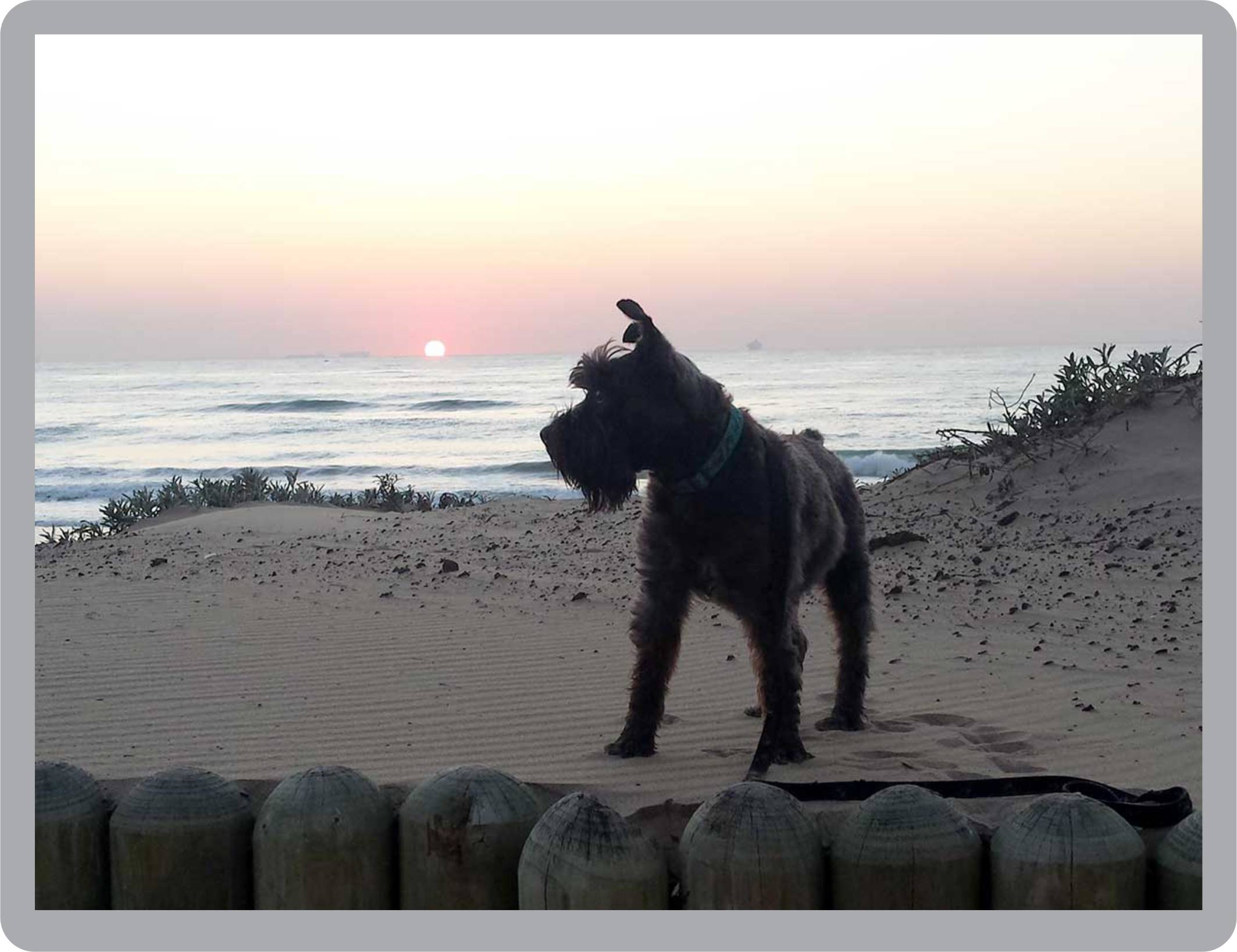
IT is the shortest day of the year, and once again we choose Durban’s beachfront as the place to be to watch the solstice sunrise. Midwinter is without a doubt the best time of the year to be in the city. The humidity of summer is a dim memory, the days are balmy, the sea mostly calm – and in the park there is a new  girlfriend putting the seal on Gustav’s happiness.

Dance with my father

05_cranedance_web

“THIS bird is a survivor”. That was how Tanya Smith described the Grey Crowned Crane chick she was trying to catch at our place in Boston in the KZN Midlands in March this year. Tanya is the regional manager of the African Crane Conservation Programme of the Endangered Wildlife Trust and she was keen to ring the bird and take blood samples for testing.
The pair of cranes nesting in our wetland produced three chicks this year, but two of them were predated. By trying to catch this one as it leopard crawled into thick vegetation to hide, it became clear why it has survived so far. It was only a week later on her second attempt that Tanya managed to get hold of it and put colour rings on its legs.
Since then I have been following its progress as it is growing stronger and learning to fly. Grey Crowned Cranes are the only species of the 15 species of cranes worldwide that can perch and roost in trees overnight. But the chicks have to grow up first, and it is quite nerve-wracking to see the parents coming back to the nest at night to put the youngster to bed before flying off themselves to roost in a tree at a dam near the house. Listening to the jackals calling during the night, and knowing there are mongoose and otters at the river, you can’t help but fear that it will suffer the same fate as its siblings.
Last weekend I was delighted to see what looked like the parents teaching their chick to dance. Cranes mate for life, and singing duets and dancing form part of their pair bonding rituals. On Sunday evening the three arrived on the hillside near the dam and did some last feeding in the fading sunlight. The young craneling picked up a stick, dropped it and picked it up again. Following this playful behaviour the adults then began dancing. Junior watched, and they danced towards it, inviting it to join in. Everyone appeared quite pleased with its attempts and eventually they flew off again. Now all that remains is for the young bird to manage landing in a tree to roost overnight as well. And soon it will be ready to be introduced to the floater flock of cranes that moves around in the district. Long may it survive, and in a few years’ time I hope it will have its own mate to dance with.

Click to access Crane%20Newsletter_Nov%202014.pdf

Birds reveal their vital statistics

04_bird-ringing_web

IMAGINE finding a tick on a bird weighing less than two teaspoons of sugar. But it does happen, although it is not that common, according to Dr Dieter Oschadleus of the Animal Demography Unit at the University of Cape Town. Dieter is the co-ordinater of the South African Bird Ringing Unit and an international expert on weavers. Despite being on holiday with his family in KwaZulu-Natal, he couldn’t resist the opportunity to visit us over the weekend at the farm at Boston with the aim of ringing weavers and widowbirds in the wetland adjoining the Elands River, which in summer is a hive of activity. By now the breeding season is over and many birds have moved on, but Dieter was satisfied with his catch of 14 birds on Sunday morning. These included a Fan-tailed Widowbird, Village Weavers, Red-billed Queleas, Levaillant’s Cisticola, African Stonechat, Lesser Swamp Warbler and the African Reed Warbler on which we saw the tick. The tick was removed and placed in surgical spirits to be used for research as well.
Dieter is passionate about the benefits of ringing birds to advance knowledge about birds, which includes information about their movements and survival, as well as obtaining detailed measurements of individual species. Birds are trapped in mist nets which are set up in their flight paths. They are quickly removed and placed in cloth bags before being processed, ringed and released as soon as possible. There are special instruments to measure the length of wings, feathers, beaks, heads and legs, and a tiny scale the size of a cell phone is used to weigh them. The African Reed Warbler weighed 9,5 grams while a Village Weaver clocked up a hefty 36 grams. The condition of the feathers reveal information about age and whether the bird is moulting or has mites on them, as the tiny dots on the primaries of the Lesser Swamp Warbler showed.
We were delighted to provide a ringing venue and hope that Dieter will be back in summer to increase his catch of weavers and widows. And the presence of the tick reminded me to make sure that Gustav’s anti-tick protection was up to date.

http://safring.adu.org.za/
http://weavers.adu.org.za
http://vmus.adu.org.za/

Birding the Eastern Cape: colour is not the key

01_EC-colours_web

BY now I should have learned that colour is not important in the new South Africa. And when it comes to distinguishing one species of bird from another, it can be downright confusing. Especially when dealing with raptors. For instance, a Jackal Buzzard has such a distinctive colour pattern that no one can possibly mistake it for anything else. Except for juvenile birds. Then even birders with many hours of experience in the field can be mistaken when an individual displays the colour pattern of a totally different bird. This is where cameras are becoming an increasingly more valuable tool in the arsenal of birdwatching equipment. Birds don’t tend to linger so one can study them in detail. But when you have managed to snap a few pictures you can spend much more time on photographs, even when they are not of top quality.

Yesterday it was eagle-eyed Ingrid Weiersbye, artist and illustrator for Roberts Birds, who spotted that what we thought was a Booted Eagle being harassed by a Cape Crow, was in fact a juvenile Jackal Buzzard. (Birding the Eastern Cape 3/4: eagle gives crow the boot). Field guides describe the eagle as having white patches on the wing near the neck. These “landing lights” are a diagnostic feature for Booted Eagle, so when we saw a pale coloured raptor with white patches in the right place, that is what we assumed it was. Ingrid, however, pointed out that juvenile Jackal Buzzards can also have these white patches.

Since our visit to the Eastern Cape I’ve attended a very informative workshop on identifying raptors held in Howick last weekend by conservationist and author Ulrich Oberprieler. The thrust of his lecture was to leave the colour of the bird to last on the list when it comes to trying to identify it. More important is its appearance, the general impression of size and shape (or GISS as most birders refer to it) and behaviour. Looking at my pictures I could see that the bird was behaving like a buzzard and not an eagle. And most telling, which we should have picked up on at the time, was that its legs, or tarsi, were bare and not feathered as it would’ve been in an eagle.

Birders find raptors notoriously difficult to identify because of the difference in colour patterns between adults and juveniles which can differ from year to year until the bird matures in about five to six years. But according to Ulrich, if you work systematically with key features, it becomes much easier. Thank you to the publishers who bring out field guides to help us mere mortals, you are doing a great job! I have it on good authority that the next Roberts Bird Guide will have far more illustrations of juvenile birds.

As far as Gustav is concerned, he doesn’t care what colour or shape other dogs are, as long as they smell good, he is interested.

http://ulrich.co.za/
http://www.robertsbirds.co.za/

Birding the Eastern Cape 3/4: eagle gives crow the boot

31_EC-birding_web

ONE would have thought with the sky stretching limitless into infinity that there is enough space for all creatures to share. Not so. Territorial disputes  between the masters of the skies often erupts, like we witnessed on a remote farm near Barkly East. An ambitious Cape Crow took on a Booted Eagle and after a brief skirmish they settled on nearby gate posts, with the crow continuing to hurl abuse at the eagle. But this was short-lived when the eagle launched itself at the crow, asserting its authority and the crow having to beat a retreat. In the car Gustav barely resisted from snarling at his canine companion, Vlakkie, when she decided to share the back seat with him. Gustav usually doesn’t tolerate anything on the seat with him and will think nothing of chucking off any items thoughtlessly placed next to him. This time he had to share the space with me, while Vlakkie was happy to sit on the floor in her usual spot behind her owners’ seats. But when there was some excitement and she got onto the seat to see what was happening, Gustav stood with stiff legs and his back turned to her with admirable restraint. After all, she was a lady, his hostess and older than him, so it would not do to klap her. But outside the car there was no problem, and they happily shared hunting experiences.

Birding the Eastern Cape 2/4: Fifty shades of brown

24_EC birding_hawk

WHAT can be a better way to start a day’s birding than with a lifer? This is what birders call birds they can tick off on their life lists for the first time. Our first day at Prospect Mountain Cottage near Barkly East dawned misty and chilly. I almost mistook the grey shape huddled on top of a tall tree next to the house for a dove, except it was far too large. When we grabbed our binoculars it turned out to be a Red-chested Sparrowhawk. I saw the bird for the first time only a month ago at home in the KZN Midlands, to the envy of my fellow atlasers who said they had been trying to find it for a long time. And here it was, a lifer for them and our first tick for the excursion. We saw it flying again the next day, in better light which confirmed the sighting. After coffee, it was down to business, making sure that we put the right names to the Little Brown Jobs we found sitting on fences, shrubs or stones. And at the end of the breeding season one has to keep in mind that juvenile birds haven’t yet developed the full coloration of adult plumage, all set to trick the unwary.
http://sabap2.adu.org.za/

Birding the Eastern Cape 1/4: getting there is a long long troubled road

24_EC birding_1.3_web

ONCE again we hit the road to go and make lists for the Southern African Bird Atlas Project. While driving along the route from Kokstad to Ugie and Eliot it is clear why large parts of the former Transkei remain unatlased after nearly ten years since SABAP2 began. Roads are poor, there are many rural settlements with too many animals overgrazing the countryside, leading to environmental degradation. And very few birds. At least work has begun on repairing the road between Matatiele and Maclear, but this inevitably result in many stop-go delays. Most drivers take it in their stride, but one has to keep a sharp eye out for the impatient ones recklessly overtaking on double lines or blind rises. This is apart from dodging donkeys, goats, cattle and schoolchildren. There are not many places where one can stop to stretch your legs. I managed to get coffee at a garage in Kokstad, but Gustav was left to feel unwanted at the fenced off patch of grass at the back with the “no dogs” signs. We longed for the garages on the N3 with their dedicated areas for canine travellers. We were heading to a farm in the pass between Elliott and Barkly East for two days of birding with friends. The slow going meant we arrived after sunset, but the mountains held great promise, especially when I spotted a pair of Bearded Vultures alighting high up on a rock in the gathering dusk just as the mist rolled in over the cliffs.

http://sabap2.adu.org.za/

So who needs squeaky toys?

18_toys_web


GUSTAV is a firm believer in asset management. When we go for walks in the veld at Boston in the KZN Midlands he finds trophies of varying degrees of disgustingness which he carries home and deposits in safe spots in the garden. He then likes to rearrange his investments, taking them out and banking them in another area before taking a well earned rest in the sun. But when his friend Batla from Smithfield in the Free State visited recently he was careful not to reveal his treasures. Instead they shared companionable outings and putting up a Spur-winged Goose on a misty morning. Hedging his bets is a wise move as there are many other watching eyes in the garden. I always investigate when I hear alarm calls from a party of birds which includes Dark-capped Bulbuls, Cape White-eyes, Fork-tailed Drongos and sparrows. Finding a newly shed skin from a snake under a tree where the birds were shouting the odds explained one such event, but most pleasing last week was discovering a young Spotted Eagle-Owl sitting in a tree outside my bedroom window. It was another misty, drizzly Midlands day and towards evening the owl was still around, having moved to another tree because of harassment by the bird police. I will have to speak to Gustav about paying income tax on his investments, one never knows when the authorities might strike.

And then there are the other birds of uMkhuze Game Reserve

04_Mkhuze-birds_webNO doubt the Pel’s Fishing Owl was the highlight of our visit to uMkhuze Game Reserve in northern KwaZulu-Natal last month, but it soon became clear that the reserve deserve its reputation for being a top birding destination in South Africa. We were making lists for the Southern African Bird Atlas Project and in three days easily ticked off 160 species in several pentads. I especially enjoyed seeing birds of which the distribution range is limited to the northern and eastern parts of the country and which I don’t get to see in my usual stomping grounds in the KZN Midlands. You have to keep your wits about you telling apart the brown Scrub Robins while other birds delight in flashing their colours. OK, the Black-winged Stilt does occur all over the country,  but it is a very elegant bird, unlike the African Openbill. And when it comes to rarity, the Pink-throated Twinspot ranks right up there with the owl as a regional special.

Pictured here are top row: Narina Trogon (female), Purple-banded Sunbird, Emerald-spotted Wood-Dove, Lilac-breasted Roller. Middle row: Black-winged Stilt, African Openbill, Black-bellied Bustard, Crested Guineafowl. Bottom row: Bearded Scrub Robin, White-browed Scrub Robin, Pink-throated Twinspot and Red-billed Oxpecker.

http://www.kznwildlife.com/
http://www.kznwildlife.com/index.php/accomodation/resorts/umkhuze.html
http://sabap2.adu.org.za/

Very Important Pel’s has birders flocking to KZN reserve

31_uMkhuze_owl_webHUGE fig trees lined the banks of the uMkhuze River as we walked down the middle of the bed which was completely dry at the end of winter and after months of no rain. The aim was to find an elusive bird which ranks high on any self-respecting birder’s must-see list: Pel’s Fishing Owl. This large bird, listed as Vulnerable in Southern Africa, occurs in forests along major river systems of sub-Saharan Africa, but down south the distribution is restricted to the Caprivi and Okavango, lower Limpopo rivers and a few large rivers in Mozambique and northern KwaZulu-Natal. The uMkhuze Nature Reserve is about at the end of its range in South Africa. It no longer breeds in Swaziland after Cyclone Demoina destroyed riverine forests in the Lebombo mountains in 1984, so when I heard in August that a pair has successfully hatched a chick and was raising it in the reserve I was determined to try and see the owls.

The forest was not silent as we walked along in the early morning light. Trumpeter Hornbills were flying noisily overhead, the males carrying figs to their mates holed up in nests in tree trunks while breeding. Tinkerbirds kept monotonous time, Dark-backed Weavers added melodious notes while barbets, flycatchers and Green-backed Camaroptera contributed to the general din. I was distracted by a splashing noise and was amazed to see a small waterhole where something big was moving about. My mind jumped to crocodiles, but before I could investigate further I was urgently called by the others and was just in time to see a brown shape with large wings disappearing into the trees down the river. Somewhat dismayed I was about to accept that I will have to make do with that as my sighting of Pel’s, when the guide beckoned us. And there it was, the juvenile sitting high up on a tree, clearly visible and a delight to see. Patrick explained that the owls’ diet existed mainly of fish, and when the river dries up they are dependent on the few remaining waterholes for food. It was most likely catfish or barbers I heard in the water and it was because the parents were still feeding the youngster that we were lucky enough to find them. Until it gets old enough to go foraging further away with its parents, the chick will build on its reputation as the most photographed owl this spring while birders flock to see it. With its feathers fluffed out, it sat looking inscrutable on its branch, reminding me of Gustav before he had his winter coat cut and trying to stare me down when he didn’t want to come into the house at the end of the day.

http://www.kznwildlife.com/
http://www.kznwildlife.com/index.php/accomodation/resorts/umkhuze.html

http://en.wikipedia.org/wiki/Pel’s_fishing_owl

Grey? The Karoo? Never!

09_Prieska_3_webMENTION the Karoo and most people conjure up images of straight, never-ending roads stretching into the distance through a dry and dull, grey landscape. But as soon as you stop and explore your surroundings, there is much to marvel at. Shapes, rhythms and textures in soil and plants; colours and patterns in birds and animals – all imitate and complement each other in myriad ways. A rich tapestry of life unfolds right before your eyes. It even has an accompanying soundtrack. A lark tells a melodious tale and busybody African Reed Warblers gossip in riverine undergrowth. Korhaans explode raucously from scrub and a sudden swarm of bees whizzes overhead. In the distance the clear clarion call of an African Fish-Eagle rings out over the river. We were visiting the Prieska area in the Northern Cape with its mix of succulent and Nama Karoo habitat to participate in the South African Bird Atlas Project. But making lists of birds also provided a good excuse to eavesdrop on nature.

http://en.wikipedia.org/wiki/Karoo
http://sabap2.adu.org.za/

Birds weave nests of intrigue in a dry land

03_Prieska_2_sociable-weaver_web

ONE of the stranger sights encountered by travellers to the Northern Cape are large, thatched domes on top of telephone poles. These are the colonial nests of Sociable Weavers, a bird endemic to the arid Southern Kalahari. Unlike other weavers building nests purely for breeding purposes, these highly structured nests are maintained right throughout the year and provide their residents with amazing temperature controlled accommodation. It is the largest nest build by birds anywhere and can reach four metres high and weigh several tons, especially when it becomes waterlogged during the rainy season. Several generations of birds live in the nest at one time and there is evidence that some nests can be 100 years old. Prieska lies at the southern edge of the Sociable Weavers’ distribution, but all the teams participating in last month’s atlas bash for the Southern African Bird Atlas Project were struck by the large number of nests in the area. No doubt the birds make good use of the smooth, slender poles conveniently provided by telephone and electricity suppliers and which helps counter predation by snakes or other nasties. The suppliers however are not amused by the damage to infrastructure which can be caused by these nests and have resorted to erecting separate poles with “starter kit” materials next to the poles with nests to encourage the birds to move across. Some team members found “floating nests” – where part of the nests had dislodged from the poles and were dangling from the wires. In areas where poles were scarce I was interested in looking out for nests in natural settings, such as acacia trees or tree aloes. Other interesting sightings we found were of other bird species using the nests. A Verreaux’s Eagle was seen feeding a chick on a nest on top of a colony while the nest on an adjoining pole was being used as a feeding platform by the eagles. Pygmy Falcons and Pale Chanting Goshawks are also associated with the nests while a number of smaller species such as sparrows, barbets, tits and chats make themselves at home in “guest accommodation” chambers.

http://en.wikipedia.org/wiki/Sociable_weaver
http://africageographic.com/blog/11-interesting-facts-about-sociable-weavers/
http://sabap2.adu.org.za/
http://weavers.adu.org.za/newstable.php?id=574

Aerial skirmish leads to breakdown

02_Prieska_1_w

WHEN my eye caught the battle in the sky near the Gariep Dam in the Free State I didn’t know that I was going to be stranded on the side of the road for nearly two hours. On 20 September I was travelling from Smithfield on my way to Prieska to join a team of passionate birders for a four day atlas bash. I haven’t seen a Verreaux’s Eagle in a long time and immediately stopped the car and grabbed the camera to snap a Pied Crow attacking the big bird circling above a koppie. A local resident driving past slowed down to have a chat, telling me that there were many birds in the Gariep Nature Reserve – at least 42 species. I don’t know how he arrived at that number, the SABAP2 project lists at least 207 birds for that area. By the time I got back to the car it wouldn’t start. It eventually turned out that in my haste to get the pictures, I had left the key in the ignition and not switched off completely. The lights were on and flattened the battery. It was Saturday on a deserted rural road and no more vehicles passed after the friendly conversationalist. Fortunately the car’s assistance team in Pietermaritzburg was on the ball and organised a breakdown company in Colesberg to come to my aid. And I used the waiting time to get my eye in for western birds which don’t occur in the eastern part of the country. One such secretive character was a Layard’s Tit-Babbler moving around in a shrub next to the road – far less conspicuous than an eagle. I also contemplated forgiving Gustav for blotting his copybook (in my view) a few days earlier at home in Boston when he killed a young hare in the garden. He was very pleased with himself, not in the least disturbed by my distress. I had left him behind with friends in Smithfield, but alone on the side of the road I missed his presence on the back seat. It was late afternoon when I finally arrived at Prieska in the Northern Cape, ready for a few days’ hectic birding with the aim of getting as many lists of birds we can for the atlas project.

http://sabap2.adu.org.za/

Secretarybird faces bleak future

04_Tillietudlem_webTHE Secretarybird with outstretched wings features prominently on the South African Coat of Arms as “a symbol of divine majesty”, but alarm bells are ringing about the conservation status of this bird. A recently published study show significant population decreases. Of interest is a statement that “the usual culprits, such as land transformation, afforestation, poisoning and powerline collisions” are no solely to blame for the decline in areas such as the Kruger National Park. Bush encroachment turned out to be a major problem, since the birds needs vast tracks of open grasslands to survive. As one of many “citizen scientists” whose observations of bird sightings contribute to the data base for studies like these I feel privileged whenever I spot one of these birds. There are currently a possible three nesting sites in the area around Boston in the KZN Midlands. During the past month the assistant manager of Tillietudlem Game and Trout Lodge, Wesley Dragt, has been seeing a pair of birds at a nest on a tree on their land. While atlasing there last week he drove me up a rocky ridge to have a look. The birds were not in attendance, but the next day I saw a bird flying near another nesting site on the other side of the mountain. It is encouraging that the owners of the lodge are removing alien trees on the property and are interested in protecting the grasslands, in the past working with BirdLife South Africa’s conservation officers. Gustav’s interest was discovering the creatures that lurked on the rocks (ideal Secretarybird cuisine). My atlas list for the morning totalled 50 birds, which included Ground Woodpeckers, and our national bird, the Blue Crane – another threatened species. It was also a delight watching a normally shy bird, the Black Crake, practising its balancing act in a reed bed.

http://bit.ly/WsJmel
https://www.facebook.com/secretarybirdconservation
http://www.sahistory.org.za/national-coat-arms
http://www.kzncrane.co.za/
https://www.ewt.org.za/accp/accp.html
https://www.facebook.com/tillietudlem

Birds and bikers scramble for space

17_rural-atlas_web

FINDING a helicopter hovering overhead in an icy wind and motorcycles scrambling across rocky terrain was the last thing I expected when I went bird atlasing along the uMkomazi River near Bulwer in the KZN Midlands this weekend. From previous experience and looking at the map I knew we would come across rural settlements on the hillsides and plenty of cattle, so the “Weekend Warrior” bikers from Gauteng came as a surprise. My birding companion and I had lost our way among the many dirt roads trying to pinpoint the area we targeted for atlasing. We stopped to speak to the pilot next to his helicopter parked on a level spot and he told us about 250 bikers had set off that morning from a guest farm near Bulwer on a 80 km round trip that took them across the countryside. But the pilot’s bird’s eye view didn’t help us with our navigation problems on the ground, so we ended up doing lists for three other pentads. There were many interesting sights, like crossing a bridge more than a 100 years old, and watching the habitat change from exposed grass-covered mountainsides dotted with soap aloes to sheltered thornveld along the banks of the river. The birds you see change with the habitat and amongst the thorns there were Golden-breasted Buntings and Blue Waxbills. We were especially pleased to find three Southern Ground-Hornbills on the banks of the river. Classified as endangered this species faces major threats due to a loss of habitat. It is estimated there are only about 1500 Ground-Hornbills left in South Africa, of which half are within the protected areas of the greater Kruger National Park. Gustav remained oblivious to the birds’ plight as he went in pursuit of a particularly nasty (to us) smell, which cut short our tea break.

http://www.ground-hornbill.org.za/
http://www.ashtonvaleguestfarm.co.za/

The case of the curious pelican

02_pelicans_webFIRST it was a feather, then a plastic bottle top and finally a dried leaf. With unexpected dexterity the Pink-backed Pelican wielded its huge bill, picking up and examining the items, tossing it in the water, retrieving it and repeating the exercise while the rest of the pod sat preening themselves and oiling their feathers after an early morning feed. I watched the pelicans yesterday morning at the model yacht basin at the uMngeni River estuary in Durban. They were cruising around in the little pond, forming a circle and simultaneously dipping their heads under the water to scoop up small fish and prey items they corralled together. Cormorants and gulls waited on the sidelines to pounce on any by-catch as they worked their way up and down the water. With their bellies full, they climbed on to the bank where four of the big birds then proceeded to clean their feathers and doze off contentedly. But one bird appeared bored, or maybe curious. It kept picking at strands of grass along the water’s edge and anything else that drew its attention, playing and amusing itself. So why did the pelican do it? I guess just because the hellican. (With apologies to the poet!)

A funny old bird is a pelican.
His beak can hold more than his belican.
Food for a week
He can hold in his beak,
But I don’t know how the helican.
– Dixon Lanier Merritt (1879–1972)

Pretoria is not only about jacarandas

25_wonderboom_webPRETORIA is known worldwide for the spectacular displays its jacaranda trees produce in spring, but a winter visit gave a new perspective on the city’s trees, introduced or indigenous. I was most intrigued to meet the equally famous “Wonderboom” for the first time recently. This is a more than 1000 years old wild fig (Ficus salicifolia) which is growing in a nature reserve on the northern slopes of the Magaliesberg in the suburb named after the tree. The Voortrekker leader Hendrik Potgieter marvelled at the “miracle tree” in the early 1800’s when it was big enough for 1000 people or 22 ox-wagons with 20 oxen in front of each to shelter under its branches. Tswana legend holds that a famous chief lies buried at the tree, explaining its enormous spread. In 1870 a fire reduced its size drastically and it has since also become the victim of a parasitic infestation. The original tree trunk is five metres thick, while some of the massive limbs touching the ground have taken root, resulting in 13 “daughter” trees forming a grove of connected trees covering an area of about 50 metres. I was very pleased to find a family of Natal Spurfowl scratching in the dry grass under the tree with the incessant roar of traffic not far off. A walk on the koppie also produced a magnificent naboom tree (Euphorbia ingens) and some marula trees (Sclerocarya birrea). But the need to retract in a laager behind bars and fences to cope with the accompanying crime of living in a city is very apparent when taking Gustav for a walk in the streets of the suburb. He enjoyed meeting another Miniature Schnauzer, but mostly his street fighting instincts were aroused by big burly hounds flinging themselves snarling at gates.

http://www.pretoria.co.za/directory/attractions/nature-reserves/wonderboom-nature-reserve.html
http://www.plantzafrica.com/

Mandela and Jan Smuts: Gustav meets two giants

22_spcawalk_webOVER the Mandela weekend Gustav spent 67 minutes walking for charity at the Jan Smuts House Museum in Irene near Pretoria. The Tshwane SPCA organised a dog walk in the grounds of the museum on Saturday to raise much needed funds, but for me the occasion tied together an interesting few strands. The day before, 18 July, was Nelson Mandela’s birthday, but it was also my cousin’s birthday on which he celebrated a significant milestone. This brought together a number of members of the Smuts family for a kuier. My branch of the Smuts family is distantly related to the General, so when the opportunity presented itself to mark Mandela’s life at the house where Jan Smuts and his family lived, Gustav and I didn’t hesitate. He was on his best behaviour, chatting up girls, meeting new friends and uncharacteristically showing some diplomatic restraint when outsized by gentle giant Amigo. (And no, Gustav hasn’t put on weight. He disdains wearing jackets or jerseys, hence the need to grow his own coat for winter.) Later on in the weekend we stopped off for a look at the new statute at the Union Buildings and I idly fantasised about eavesdropping on the conversation if Smuts and Mandela could have taken their dogs for a walk together in the veld.

https://www.facebook.com/TshwaneSPCA
http://www.spcapta.org.za/
http://www.smutshouse.co.za/


It is a falcon vs eagle dogfight in sky over Durban

14_finfoot-loopAN AEROBATIC display that would’ve fitted in well at any air show was one of the highlights of a day’s birding along the uMngeni River near Durban yesterday. A young Martial Eagle was attacked by a Lanner Falcon intent on chasing it from its territory. It was interesting to compare the sizes and shapes of the two raptors in relation to each other. The smaller, streamlined Lanner is obviously built for speed while the eagle has large wings for soaring most of the day while it hunts for small mammals, birds or reptiles. Its wingspan can reach up to 2.4 metres. The falcon’s prey consists mostly of birds like francolins, lapwings or mousebirds, hence its need for speed. It will take birds in midair strikes after being flushed, or close to the ground.

The birders used the opportunity created by the city’s Green Corridor project for people to practise their outdoor activities along the river. We hired their guide, Joe, whose mission it was to provide us with a view of the shy, elusive bird after which they have named their birding route: the Finfoot Loop. I never pass up the chance to make lists for the SABAP2 bird atlas project and it was great to have everyone calling out their sightings. The route took us through four pentads, and although it is mid-winter, we had good numbers of species in all of them: 32, 58, 48 and 33. This is encouraging, because everywhere we went we were aware of the pressure of human settlements and its attendant problems. Roads are being built, homes are spreading out over the hillsides, there is a need for water and grazing, and littering takes place in many places, despite the best efforts of the Duzi and uMngeni Conservation Trust to deal with pollution. I will certainly think twice before emulating Gustav in drinking water from the river.

We stopped at several sites along the river in search of the African Finfoot, to no avail. At the place where I saw the bird on a previous occasion earlier this year a truck was pumping water from the river and the noise was enough to put off even far less reclusive species. It was only at the last stop below the Inanda dam wall, when people’s thoughts were turning to braai fires and replenishing their thirst, that one determined birder who was closely scrutinising the streambed and overhanging vegetation raised the call. Only three of us managed a glimpse before it disappeared again. But the bird was more obliging later on, when some suitably refreshed members on their way home decided to have a last try at spotting it and was rewarded with good views.

http://www.durbangreencorridor.co.za/
https://www.facebook.com/DurbanGreenCorridor
http://www.duct.org.za/
http://sabap2.adu.org.za/